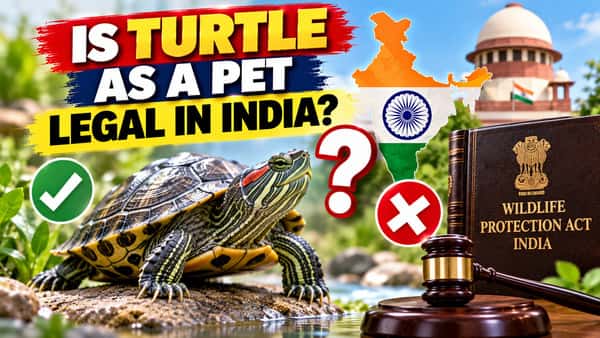
Is turtle as a pet legal in India? Not if the turtle or tortoise is a native Indian species: the Wild Life (Protection) Act, 1972 protects every native species, most of them under Schedule I, so keeping, buying or selling one is an offence, while the status of exotic species such as the red-eared slider is described inconsistently by different guides. This is general information, not legal advice, and you should check the species and the current schedules before you buy anything.
Quick Facts
| Question | Short answer | Basis |
| Can I keep a native Indian turtle or tortoise? | No | Wild Life (Protection) Act, 1972 |
| Is the Indian star tortoise legal as a pet? | No | Schedule I protection, per RESQ |
| Can I buy one from a shop or breeder? | Not a protected native species | Possession and trade offences |
| What about exotic turtles like the red-eared slider? | Guides disagree | See below |
| Penalty for Schedule I offences | 3 to 7 years and a minimum fine | Section 51 |
| Can I release an unwanted turtle? | No | Harms ecosystems, often illegal |
The Short Answer
The law protects the animals, not the hobby.
- RESQ Charitable Trust says it is illegal to keep most turtle and tortoise species, and that the Act protects every native species found in India
- With the Wild Life (Protection) Amendment Act, 2022 in effect, most are under Schedule I protection, “equal to the protection a tiger receives,” according to RESQ
- The Environmental Literacy Council says keeping turtles is legal with significant caveats: native species are illegal, but exotic species are permissible
Native Species
These are the clear cases.
- The Indian star tortoise is the most commonly traded, and keeping one as a pet is illegal, according to several guides
- Owning, trading or attempting to export one is a serious offence, according to the Environmental Literacy Council
- International trade in the Indian star tortoise is illegal under CITES, even if the animal was bred in captivity
- One guide names Indian eyed turtles and Indian roofed turtles among the protected species, though these lists vary
Why Schedule I Matters
The schedule decides the penalties and the bail rules.
- For offences involving Schedule I animals, the minimum imprisonment is three years, which may extend to seven, with a minimum fine
- Section 51A adds conditions for granting bail, according to Wikipedia
- Wikipedia also says no person can now acquire Schedule I animals, articles or trophies except by inheritance, with live elephants excluded
- That means a protected native turtle bought from a pet shop can’t be legitimised later
Exotic Species: Where Guides Disagree
The red-eared slider shows how inconsistent the advice is.
- The Environmental Literacy Council and one other guide say the red-eared slider, Reeve’s turtle, painted turtle and African sideneck turtle can be legally kept as pets because the Act primarily targets native species
- Law Legal Hub and two other guides say the Indian star tortoise and the “Red Ear Slider” are both illegal to keep, which may reflect confusion between look-alike species
- Petshun’s article contradicts itself, saying the red-eared slider is both illegal and permissible with information provided to the respective department
- I couldn’t verify a clear current rule on exotic turtles, so check with your state forest department before buying one
Exotic Doesn’t Always Mean Safe
Paperwork and trade rules still bite.
- Over 300 African sulcata tortoises were rescued by the Railway Police Force in Maharashtra from being transported for the illegal pet trade, according to RESQ
- Buying from an unregistered source, or one without documents, can bring trouble even if the species isn’t native
- Exotic animals can also carry diseases, and most animals don’t show symptoms until they deteriorate, according to RESQ
Why the Red-Eared Slider Is a Problem
Even where legal, it’s an invasive risk.
- RESQ calls it an exotic species from the United States that greatly threatens India’s biodiversity
- The Environmental Literacy Council says that while legal, sliders can become invasive if released into the wild
- Releasing a pet turtle can harm local ecosystems and is often illegal, according to the same guide
- Red-eared sliders can live 15 to 30 years, so it’s a long commitment
What the Law Targets
The offences reach beyond ownership.
- Capture, trade and possession of protected turtles without proper licensing are illegal, according to one guide
- Selling a protected species can bring the same penalties as keeping one
- Enforcement works with groups such as the Turtle Survival Alliance to stem the illegal pet trade, according to Law Legal Hub
If You Already Have One
A few steps are safer than doing nothing.
- Identify the species with help from a wildlife vet or rescue group
- If it’s a native species, contact your state forest department or a wildlife rescue organisation instead of keeping or releasing it
- Don’t release it into a pond or river
- Keep records of where it came from, since that will matter to the authorities
FAQs
Q1. Is it legal to keep a turtle as a pet in India?
A. Native Indian turtle and tortoise species that are protected under wildlife law cannot generally be legally kept as pets without the required authorization. Rules concerning exotic species can differ, so their legal status and documentation requirements should be verified with the relevant State Forest Department before acquiring one.
Q2. Is the Indian star tortoise legal as a pet?
A. No. The Indian star tortoise is a protected species, and unauthorized possession, trade, capture, or export can attract action under India’s wildlife laws. Its international trade is also regulated under CITES.
Q3. Is the red-eared slider legal in India?
A. The legal position and regulatory requirements concerning red-eared sliders, an exotic and invasive species, can be complicated. Before acquiring one, check the latest requirements with the State Forest Department or other competent wildlife authority. It should never be released into the wild, as it can harm native ecosystems.
Q4. What is the penalty for keeping a protected turtle?
A. Unauthorized possession of a protected turtle or tortoise can lead to serious penalties under the Wild Life (Protection) Act, 1972. The exact imprisonment term, fine, and bail provisions depend on the species, its applicable schedule, the nature of the offence, and the current provisions of the Act.