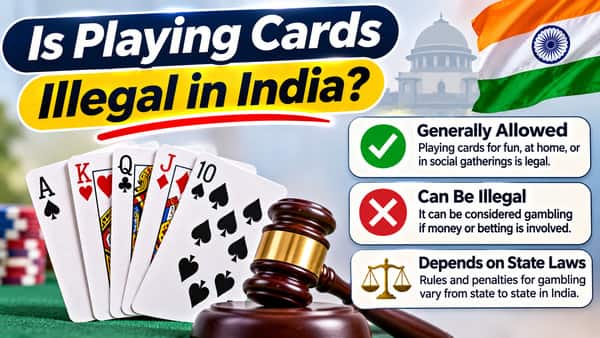
Is playing cards illegal in India? No: playing cards is not illegal, but betting money on card games can be, depending on the game, the place and the state, and online real-money card games, including rummy and poker, have been banned nationwide since 2026. This is general information, not legal advice, and state laws differ.
Quick Facts
| Situation | Status | Basis |
| Playing cards for fun, no stakes | Legal | No law prohibits it |
| Gambling on a game of chance, such as teen patti | Illegal in public places and gaming houses | Public Gambling Act, 1867 and state laws |
| Running or being in a common gaming house | Illegal | Public Gambling Act Section 3 |
| Rummy for stakes offline | Treated as a game of skill, but state laws vary | Satyanarayana, Supreme Court |
| Real-money online cards, including rummy, poker, teen patti | Banned nationwide | PROG Act, 2025 and Rules, 2026 |
| Casino play | Legal only where licensed, in Goa, Daman and Sikkim | State frameworks |
The Short Answer
Cards are a pastime, and the law targets gambling.
- Law Unfold says playing cards isn’t illegal, but playing specifically to bet and earn money is illegal in many settings
- Gambling in public areas or running gambling operations is against the law, according to the same guide
- A festival or family setting doesn’t change the legal test, which turns on stakes, venue and the type of game. That’s my reading of the sources, not a statement they make
The Public Gambling Act, 1867
The old central law still frames the answer.
- It prohibits running or being in charge of a common gaming house and gambling in one, according to Lawrato
- Section 12 says no game of mere skill, wherever played, is covered by the Act
- Many states have adopted the Act, while others have passed their own gambling laws, so the rules depend on where you are
- The Act doesn’t address online gambling, which is why courts and legislatures have had to fill the gap
Penalties
Figures differ by source and by state.
- Lawrato says the Act prescribes a fine of up to ₹200 or imprisonment of up to three months
- The Association of Certified Gaming Compliance Specialists says Section 3 carries a fine up to ₹1,000 or six months, and Section 4 a fine and up to two years
- Under the Goa, Daman and Diu Public Gambling Act, 1976, running a common gaming establishment can bring up to three years and a fine of ₹2,000
- States have amended penalties, so the amount and the jail term depend on your state’s law
Skill Versus Chance
The courts split card games into two groups.
- In State of Bombay v. R.M.D. Chamarbaugwala, the Supreme Court held that games predominantly of skill, despite an element of chance, are games of skill
- Rummy was held “mainly and preponderantly a game of skill” in Satyanarayana, dated 1967 in Wikipedia and 1968 in the Supreme Court Observer
- Teen patti, by contrast, is treated as a game of pure chance, and Wikipedia describes it as a gambling card game
- Poker varies by state: West Bengal excludes it from gambling, and Nagaland treats it as a game of skill, according to Seth Associates
State Differences
Some states are stricter than others.
- Law Unfold says that in Assam, Odisha and Telangana, playing card games for money is illegal whether it’s skill or chance, though that guide is two years old
- Andhra Pradesh and Telangana have also banned online rummy for stakes, citing addiction and financial loss
- Check your state’s gambling act, since rules vary and I couldn’t verify each state’s current position
Online Card Games
The online position changed completely in 2026.
- The Promotion and Regulation of Online Gaming Act, 2025 bans online money games regardless of skill or chance, and took effect with its Rules on 1 May 2026, according to several sources
- The Supreme Court Observer says that in May 2026 the Court clarified that games of skill, when played with stakes, constitute gambling, and that states can ban online real-money games
- That includes online rummy, teen patti and poker for money
- A challenge to the central Act is pending before a three-judge bench
- Esports and online social games without monetary stakes remain permitted
What About Playing at Home?
The sources are less clear here.
- The Public Gambling Act targets common gaming houses and public gambling, and the guides I found don’t give a clear rule for small private games among family
- Playing for small stakes at home is therefore a grey area, and state laws can be broader than the 1867 Act
- Hosting regular games for money, taking a cut or letting strangers in moves you toward the “common gaming house” offence
- If you want zero risk, play without stakes
Practical Guidance
A few rules of thumb reduce risk.
- Play for fun, with no money on the table
- Avoid public places, clubs and any setting where a house takes a share
- Don’t host regular games for money
- Don’t play real-money card games online, since they’re banned nationwide
- Check local police advisories during festivals, when raids are more common, though I didn’t find sourced figures on that
FAQs
Q1. Is playing cards illegal in India?
A. No, playing cards for fun isn’t illegal. Betting money on card games can be, depending on the game, the place and the state.
Q2. Is teen patti illegal?
A. When played for money, it’s treated as a game of chance and counts as gambling, and it’s illegal in public places and gaming houses.
Q3. Is rummy legal?
A. Offline rummy has been held a game of skill, but state laws vary. Online real-money rummy is banned nationwide.
Q4. What is the penalty for gambling?
A. It varies. The 1867 Act is quoted at up to ₹200 or three months, and some state laws allow up to three years.