Choosing a tap may appear to be a small decision during a bathroom or kitchen renovation, but it directly affects everyday convenience. Think about washing your hands with soapy fingers, quickly adjusting shower temperature, filling a vessel in the kitchen or helping a child use the basin. The way a tap controls water flow and temperature can make these routine tasks either effortless or unnecessarily complicated.
For Indian homes, single lever taps and double handle taps are two popular choices. A single lever tap controls hot and cold water through one handle, offering quick one-handed operation and a clean modern appearance. A double handle tap provides separate controls for hot and cold water, giving users independent adjustment and a more traditional look.
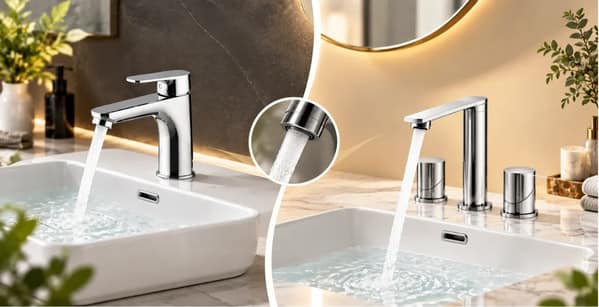
Neither design is automatically better. Your ideal choice depends on whether hot water is available, plumbing configuration, water pressure, maintenance preferences, bathroom style and how frequently the fixture will be used.
Single Lever vs Double Handle Taps: Quick Comparison
| Factor | Single Lever Tap | Double Handle Tap |
|---|---|---|
| Controls | One lever | Separate hot and cold controls |
| Operation | Quick and convenient | Requires separate adjustment |
| Temperature Control | Adjusted through one lever | Hot and cold mixed independently |
| One-Handed Use | Excellent | Less convenient |
| Appearance | Modern and minimal | Classic to premium |
| Cleaning | Usually easier | More components to clean around |
| Installation | Depends on tap configuration | May require more components/openings |
| Maintenance | Cartridge is important | Valve/cartridge system varies |
| Best For | Modern kitchens and bathrooms | Traditional designs and independent control |
| User Convenience | Generally high | More deliberate adjustment |
What Is a Single Lever Tap?
A single lever tap uses one handle to manage both water flow and temperature.
Typically, lifting or moving the lever controls water volume, while moving it from one side to another changes the balance between hot and cold water.
Single lever mixers are commonly installed in:
- Bathroom basins
- Kitchen sinks
- Vanity counters
- Shower systems
- Modern apartments
- Hotels and premium bathrooms
The biggest attraction is convenience. Instead of operating two separate controls, users can adjust the water with one hand.
This can be particularly useful in kitchens, where one hand may already be occupied with utensils, vegetables or cookware.
What Is a Double Handle Tap?
A double handle tap has separate controls for hot and cold water.
Depending on the design, the two controls may be part of one fixture or installed separately around the spout.
The user opens each side and adjusts the flow until the desired temperature is achieved.
Double handle taps are often found in:
- Traditional bathrooms
- Classic interior designs
- Premium basin installations
- Vintage-style bathrooms
- Certain widespread basin configurations
Their main advantage is independent control over hot and cold supplies.
For homeowners who prefer traditional styling or more deliberate temperature adjustment, double handle taps remain an attractive option.
Which Is Easier to Use?
For everyday convenience, the single lever tap generally has an advantage.
You can usually turn the water on, adjust the flow and change the temperature using one hand.
This is particularly convenient when:
- Your hands are dirty while cooking.
- You are washing your face.
- You are holding a container.
- Children use the basin.
- You need to turn water on and off frequently.
Double handle taps require separate operation of the hot and cold controls.
This is not difficult, but achieving a comfortable mixed temperature may take a little longer.
For a frequently used kitchen or bathroom basin, the difference becomes noticeable over time.
Which Offers Better Temperature Control?
Both designs can provide good temperature control when the tap and plumbing system are properly designed.
A single lever mixer allows quick adjustment by changing the lever position.
Once users become familiar with the tap, they can often return the lever to approximately the same comfortable position each time.
Double handle taps allow hot and cold flow to be adjusted independently. Some users prefer this because they can make small changes to either supply.
However, neither tap type should be confused with a thermostatic mixer.
A standard single lever or double handle mixer does not necessarily maintain a fixed safe water temperature if supply conditions change.
This is especially important where very hot water is supplied from a geyser.
Which Can Help Save Water?
The tap design itself does not automatically determine water consumption.
However, a single lever can make it faster to turn the water on and off and reach the desired flow, potentially reducing unnecessary running during frequent short tasks.
Actual water consumption depends more directly on:
- Flow rate
- Aerator
- Water pressure
- User habits
- Cartridge or valve design
- Leakage
A quality aerator can reduce water flow while maintaining a useful stream.
Therefore, if water efficiency is important, check the tap’s flow characteristics rather than assuming a single lever or double handle will automatically save more water.
Which Is Better for Indian Kitchens?
Single lever mixers are particularly practical for kitchens.
Imagine kneading dough, cleaning vegetables or handling oily utensils. Operating a single lever with one relatively clean hand or wrist can be much easier than adjusting two separate handles.
Other useful kitchen features may include:
- Swivel spout
- Pull-out spray
- Flexible hose
- Aerator
- Multiple spray modes
- Easy-to-clean outlet
Double handle taps can still work perfectly well in kitchens, particularly where homeowners prefer a traditional aesthetic.
But from a convenience perspective, a good-quality single lever mixer is often the more practical choice for a busy Indian kitchen.
Which Is Better for Bathrooms?
Both designs work well in bathrooms, so the decision often comes down to convenience and appearance.
Single lever taps complement:
- Modern vanities
- Countertop basins
- Minimalist bathrooms
- Contemporary apartments
- Compact spaces
Double handle taps complement:
- Traditional bathrooms
- Heritage-inspired interiors
- Luxury classical designs
- Decorative basins
For a family bathroom that is used frequently throughout the day, single lever operation can be particularly convenient.
For a premium guest bathroom where appearance is a major consideration, a carefully selected double handle design can become an attractive visual feature.
Cleaning and Maintenance
Single lever taps often have a relatively clean external design with fewer separate handles and gaps.
That can make wiping the basin area easier.
Double handle taps have additional components around which:
- Soap residue
- Dust
- Water
- Hard-water deposits
may collect.
This difference can matter in Indian cities with hard water, where white mineral deposits can quickly become visible around fixtures.
Regardless of tap type:
- Wipe water marks regularly.
- Clean the aerator periodically.
- Avoid abrasive scrubbers.
- Use only suitable cleaning products.
- Repair dripping taps promptly.
Routine cleaning is much easier than removing heavy mineral deposits later.
Repair and Internal Components
The internal mechanism is one of the most important factors when buying either tap.
Many modern single lever mixers use ceramic cartridges that control both flow and mixing.
If the cartridge eventually develops a problem, replacement may restore normal operation without replacing the entire tap—provided the correct spare is available.
Double handle taps may use separate cartridges or valve mechanisms for hot and cold water.
This can mean that a problem on one side may sometimes be repaired independently.
Before purchasing an expensive tap, ask whether replacement cartridges and other spare parts are readily available.
A beautiful imported fixture can become frustrating if a small replacement component is impossible to source several years later.
Installation Requirements
Installation depends on the particular tap model rather than simply the number of handles.
A single lever mixer may use flexible connections for hot and cold supplies and can often be installed through a compact mounting arrangement.
Double handle configurations may require separate mounting holes or additional spacing depending on the design.
Before buying, check:
- Number of mounting holes
- Hot and cold inlet arrangement
- Basin or sink compatibility
- Available space below the counter
- Water pressure requirements
- Connection sizes
This is especially important when replacing an existing tap without changing the basin or countertop.
Which Looks Better?
Appearance is subjective, but the two styles create noticeably different visual effects.
Single Lever
A single lever usually looks:
- Clean
- Minimal
- Contemporary
- Compact
- Streamlined
It works particularly well with modern Indian bathroom and kitchen designs.
Double Handle
Double handle taps can look:
- Traditional
- Elegant
- Decorative
- Symmetrical
- Luxurious
They pair especially well with classical interiors, stone countertops and vintage-style basins.
Both types are available in finishes such as chrome, brushed metal, black, gold-toned and other decorative options.
Which Is Better for Elderly Users?
Single lever taps can be easier for many elderly users because they require fewer individual movements.
A large lever may also be easier to operate than small knobs for someone with reduced hand strength or dexterity.
However, ease of operation varies considerably by product.
When choosing for elderly family members, test:
- Handle resistance
- Grip
- Required movement
- Temperature adjustment
- Accessibility
For households with children or vulnerable users, hot-water temperature safety should also be considered separately.
Cost: Which Is More Expensive?
There is no fixed rule.
The price of either tap can vary from a basic model to a premium designer fixture.
Cost depends on:
- Body material
- Cartridge quality
- Finish
- Brand
- Spout design
- Installation type
- Additional features
- Warranty
A high-quality single lever mixer may cost more than a basic double handle tap, while a luxury double handle set can be considerably more expensive than a standard single lever model.
Compare quality at a similar price and specification level, not simply the number of handles.
Common Mistakes to Avoid
Before choosing a tap, avoid:
- Selecting only by appearance
- Ignoring existing plumbing connections
- Buying without checking mounting holes
- Ignoring cartridge quality
- Assuming expensive means maintenance-free
- Choosing a tap unsuitable for available water pressure
- Forgetting about spare-part availability
- Ignoring hard-water maintenance
- Using harsh chemicals on decorative finishes
The body material, cartridge, aerator, hoses and installation quality together determine how well the tap performs.
Single Lever or Double Handle: Which Should You Choose?
Choose a single lever tap when:
- Quick one-handed operation is important.
- You prefer modern styling.
- The fixture will be used frequently.
- Easy cleaning is a priority.
- You want convenient hot-and-cold mixing.
Choose a double handle tap when:
- You prefer separate hot and cold controls.
- Traditional or classical styling suits your interior.
- Independent adjustment is important to you.
- Your basin or countertop is designed for that configuration.
For most modern Indian kitchens and frequently used bathrooms, a single lever mixer offers excellent everyday convenience. However, a quality double handle tap remains an excellent choice when independent control and traditional styling are priorities.
FAQs
1. Is a single lever tap better for a kitchen?
A. For many kitchens, yes. One-handed operation makes it convenient when cooking, washing utensils or filling containers. Look for a model with a useful spout reach, good cartridge and suitable swivel movement rather than choosing only by appearance.
2. Can I replace a double handle tap with a single lever tap?
A. Often yes, but it depends on the existing mounting holes, hot and cold supply connections, basin or countertop design and available space. Check these measurements before buying the replacement.
3. Why has my single lever tap become difficult to move?
A. Mineral deposits, cartridge wear or internal contamination may make lever movement stiff. Hard water can contribute to scale accumulation. Cleaning or cartridge servicing may help, but use manufacturer-approved replacement parts.
4. Which type is easier for children and elderly people?
A. A smooth, easy-to-operate single lever is often more convenient because it requires fewer hand movements. However, hot-water safety is equally important. Where scalding is a concern, appropriate temperature-control measures should be considered rather than relying on the tap design alone.