Imagine two companies facing the same problem: customer complaints are increasing. In the first company, senior management studies the issue, decides what must change and sends new instructions to every department. Employees are expected to implement the plan. In the second company, managers first ask customer-support staff, sales teams and operational employees what they are seeing on the ground. Their feedback helps shape the final solution.
These situations illustrate top-down and bottom-up management styles.
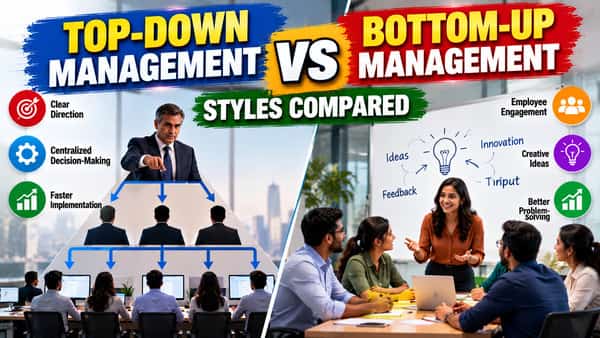
Top-down management concentrates direction and major decision-making at senior levels. Bottom-up management gives employees and lower-level managers a stronger voice in identifying problems, suggesting improvements and influencing decisions.
For Indian businesses, neither approach is automatically superior. A top-down structure can provide speed and consistency when clear direction is essential. A bottom-up approach can generate practical ideas and stronger employee involvement, particularly when frontline teams understand customers and operations better than senior management.
The most effective choice depends on company size, industry, urgency, employee capability and the type of decision being made.
Top-Down Vs Bottom-Up Management: Quick Comparison
| Factor | Top-Down Management | Bottom-Up Management |
|---|---|---|
| Decision Authority | Senior leadership | More distributed |
| Direction | Leadership-driven | Employee input influences direction |
| Speed | Often faster | Can take longer |
| Employee Participation | Lower | Higher |
| Standardisation | Strong | More flexible |
| Innovation | Leadership-led | Can emerge across teams |
| Communication | Mainly downward | More two-way |
| Local Knowledge | May be underused | Stronger use |
| Accountability | Clear at leadership level | More distributed |
| Crisis Management | Often effective | May be slower |
| Employee Ownership | Can be lower | Often stronger |
| Best For | Urgency and consistency | Innovation and local problem-solving |
How Top-Down Management Works
In a top-down organisation, senior leaders establish major goals, strategies and policies.
These decisions move downward through the management hierarchy.
For example:
CEO → Department Head → Manager → Team Leader → Employee
Senior management may decide that the company needs to reduce delivery time by 20%.
Department heads then determine what their teams need to do, managers assign responsibilities and employees execute the plan.
The major advantage is clarity.
Everyone knows where the direction came from and what the organisation expects.
Top-Down Management Can Make Decisions Faster
Businesses sometimes need immediate decisions.
Imagine a company discovers a serious cybersecurity problem. Waiting several weeks for organisation-wide discussion would be impractical.
Senior management may need to:
- Restrict system access
- Change security procedures
- Allocate emergency resources
- Bring in specialists
- Communicate mandatory instructions
A top-down approach can be effective because decision authority is clear.
The same applies during financial emergencies, regulatory problems, safety incidents or major operational disruptions.
When the organisation needs one coordinated response quickly, extensive consultation may not always be practical.
Consistency Is a Major Advantage
Top-down management can help large organisations maintain consistent standards.
A nationwide retail company, for example, may want every location to follow the same basic policies for:
- Brand presentation
- Product quality
- Customer data
- Accounting
- Safety
- Compliance
If every branch independently developed these rules, the company could become difficult to control.
Central direction helps establish minimum standards.
This can be particularly important where mistakes create financial, legal or reputational risks.
But Senior Leaders May Be Too Far From Daily Problems
One weakness of top-down management is distance.
Senior executives may understand strategy very well but may not experience everyday operational problems directly.
For example, management might introduce a new customer-service procedure that looks efficient in a presentation.
Frontline employees may quickly discover that it actually adds five minutes to every customer interaction.
If employees have no practical way to communicate this problem upward, the organisation may continue using an inefficient system.
Good top-down management therefore still needs feedback channels.
Employees Can Become Passive
If employees are repeatedly told exactly what to do without being asked for ideas, they may eventually stop suggesting improvements.
Their attitude can become:
“Management decides. I just follow.”
This can reduce initiative.
Potential consequences include:
- Lower ownership
- Missed improvement opportunities
- Slow problem escalation
- Reduced engagement
- Dependence on senior managers
An organisation does not want employees challenging every instruction, but it also should not train capable people to stop thinking independently.
How Bottom-Up Management Works
Bottom-up management creates greater employee participation in decision-making.
This does not necessarily mean employees control the company.
Senior leadership still remains accountable for overall strategy.
The difference is that ideas and information can travel upward.
For example, a retail employee might notice that customers repeatedly ask for a particular product.
That information moves to the store manager, then regional management and eventually the buying team.
If the pattern appears across several stores, the company may introduce the product nationally.
A useful business opportunity has emerged from frontline observation rather than executive planning.
Frontline Employees Often Have Valuable Information
Employees who interact directly with customers, suppliers, machines or internal systems frequently see problems before senior management does.
They may know:
- Which customer complaints occur repeatedly
- Which process wastes time
- Which product is difficult to sell
- Which software feature causes problems
- Which competitor customers mention
- Where delays occur
Bottom-up management creates mechanisms for capturing this knowledge.
That can improve decision quality.
For Indian businesses operating across different states and customer segments, local knowledge can be particularly valuable because customer behaviour and operating conditions may vary significantly.
Bottom-Up Management Can Encourage Innovation
Some of the most useful improvements are small.
An employee may discover a faster way to:
- Pack orders
- Process invoices
- Handle customer queries
- Organise inventory
- Use software
Senior leadership might never identify these opportunities independently.
When employees are encouraged to suggest improvements, innovation becomes part of daily operations rather than something limited to senior executives.
Businesses can encourage this through:
- Suggestion systems
- Team meetings
- Employee surveys
- Innovation challenges
- Cross-functional workshops
- Regular manager feedback sessions
The important part is showing employees that useful suggestions are genuinely considered.
Employee Ownership Can Improve
People are generally more committed to plans they helped shape.
Suppose management wants to redesign an internal workflow.
Under a purely top-down approach, employees receive the new procedure after it has already been finalised.
Under a bottom-up approach, the employees who actually use the workflow contribute before implementation.
This can create:
- Greater acceptance
- Better practical design
- Earlier identification of problems
- Stronger accountability
Employee participation does not guarantee agreement, but it can reduce the feeling that changes are being imposed without understanding operational realities.
Bottom-Up Decision Making Can Be Slow
The main disadvantage is time.
Consulting many employees can produce:
- Long meetings
- Conflicting opinions
- Delayed decisions
- Unclear responsibility
- Excessive discussion
Not every decision needs broad consultation.
Employees do not necessarily need to vote on company strategy, acquisitions, cybersecurity policies or confidential financial decisions.
Businesses need to distinguish between valuable participation and unnecessary consensus-building.
Listening to employees does not mean every suggestion must be accepted.
Expertise Still Matters
Bottom-up management can become ineffective when decisions are made primarily according to popularity rather than expertise.
A technical cybersecurity decision, for example, should be led by people with appropriate knowledge.
Employee feedback can still be valuable, but final authority should sit with qualified decision-makers.
The same principle applies to:
- Legal compliance
- Taxation
- Financial controls
- Workplace safety
- Engineering
- Data protection
Participation should improve decision-making rather than replace professional judgement.
Communication Flows Differ
Top-down communication typically moves from leadership towards employees:
Leadership → Managers → Employees
Bottom-up communication encourages information to move in both directions:
Leadership ↔ Managers ↔ Employees
The second model can reveal problems earlier.
However, it requires managers who are willing to listen.
A company can claim to have an “open-door culture,” but if employees are criticised every time they question a process, real bottom-up communication will disappear.
Psychological safety and professional respect are therefore important.
When Top-Down Management Works Best
A top-down approach may be particularly useful when:
- A crisis requires immediate action.
- Strong compliance is necessary.
- The company needs consistent standards.
- Decisions involve confidential information.
- Employees require clear initial direction.
- A major strategic change must be coordinated.
Speed and clarity are its strongest advantages.
When Bottom-Up Management Works Best
Bottom-up management can be valuable when:
- Innovation is important.
- Frontline employees understand customers deeply.
- Local markets differ.
- Processes need continuous improvement.
- Employee expertise is high.
- Management wants stronger ownership.
It is especially useful for identifying practical problems that may be invisible to senior executives.
The Hybrid Approach Is Often More Practical
Most businesses do not need to choose one style permanently.
A hybrid approach can use top-down management for:
- Strategy
- Budgets
- Risk
- Compliance
- Major investments
At the same time, bottom-up participation can shape:
- Product improvements
- Customer experience
- Workflow changes
- Local marketing
- Operational efficiency
Senior leaders can establish the destination while allowing employees to help determine the best route.
This approach gives businesses direction without ignoring frontline knowledge.
The goal is not to make every decision democratic or every decision executive-controlled. It is to give the right people an appropriate voice while keeping responsibility clear.
FAQs
1. Is top-down management the same as micromanagement?
A. No. Top-down management means important direction and decisions originate from senior leadership. Micromanagement occurs when managers excessively control minor details of employees’ work. A company can use top-down strategy while still giving employees significant freedom in execution.
2. Can bottom-up management work in a large company?
A. Yes, provided the organisation has systems to collect, evaluate and implement employee input efficiently. Surveys, team meetings, regional feedback, digital suggestion platforms and cross-functional groups can help large companies use frontline knowledge.
3. Which management style is better for a startup?
A. Startups often benefit from a combination. Founders may need to provide strong top-down direction because resources are limited, while employee feedback can help identify customer needs and improve products quickly.
4. How can managers encourage bottom-up ideas without losing control?
A. Define which decisions employees can influence, create structured feedback channels and explain who makes the final decision. Managers should evaluate suggestions against business goals, costs, risks and available evidence rather than accepting or rejecting ideas automatically.