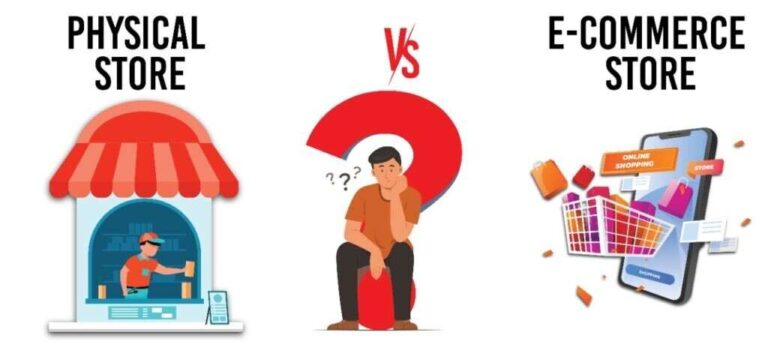
An Indian entrepreneur launching an online business often faces an important decision before the first product is even sold: should you list products on a popular online marketplace or invest in your own e-commerce website? A marketplace can put products in front of an existing pool of shoppers relatively quickly, while an independent website gives the business much greater control over its brand, pricing presentation and customer journey.
The decision looks simple until the costs and responsibilities are examined closely. Marketplace sellers may benefit from platform traffic and established customer trust, but they also face competition, platform fees and marketplace rules. Website owners gain independence and stronger branding opportunities, but they have to attract visitors themselves.
For most Indian businesses, the right answer depends on the product category, margins, marketing capability, budget and long-term goal. A seller looking to test demand may make a different choice from a company trying to build a recognisable consumer brand.
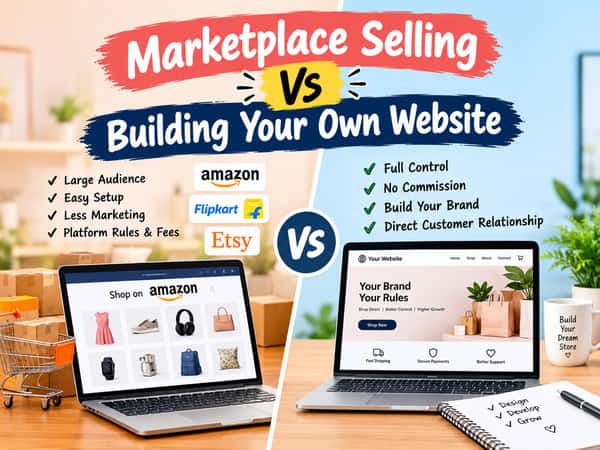
Marketplace Vs Own Website: Quick Comparison
| Factor | Online Marketplace | Own Website |
|---|---|---|
| Initial Setup | Usually faster | Requires more setup |
| Existing Traffic | Available | Must be generated |
| Customer Trust | Platform can help | Must be built |
| Competition | Very high | More controlled |
| Branding | Limited | Strong control |
| Fees | Platform-related charges | Website and payment costs |
| Pricing Control | Subject to platform environment | Greater flexibility |
| Customer Experience | Platform-controlled | Business-controlled |
| Customer Relationship | More limited | More direct |
| Marketing | Marketplace + external promotion | Business responsibility |
| Platform Dependency | High | Lower |
| Long-Term Brand Building | More difficult | Stronger potential |
Why Marketplaces Are Attractive to New Sellers
The biggest advantage of an online marketplace is access to existing shoppers.
A new independent website may launch with zero visitors. A marketplace already has consumers searching for products every day.
For a new seller, this can reduce the initial challenge of convincing people to visit an unknown store.
Marketplaces may also provide infrastructure for areas such as:
- Product listings
- Search
- Payments
- Order management
- Customer reviews
- Logistics options
- Returns
This allows entrepreneurs to concentrate more heavily on products, pricing and fulfilment rather than developing every e-commerce function from the beginning.
Marketplaces Can Help Test Product Demand
Before investing heavily in branding and website development, businesses need to know whether customers actually want the product.
Marketplace selling can be useful for testing.
A seller can study:
- Which products receive orders
- Which price points work
- Common customer questions
- Return patterns
- Customer reviews
- Seasonal demand
Suppose a business launches 20 home décor products but discovers that only five generate consistent sales.
That information can guide future inventory decisions.
Testing demand before making larger investments can reduce risk.
Competition Is Much More Visible on Marketplaces
The same feature that makes marketplaces attractive also creates their biggest challenge.
Your competitors are only a few clicks away.
A customer searching for a product may immediately see dozens of alternatives with different:
- Prices
- Ratings
- Delivery times
- Discounts
- Product images
This makes comparison extremely easy.
Businesses selling largely undifferentiated products can therefore face strong price pressure.
Reducing prices repeatedly to remain competitive can damage margins.
Successful marketplace sellers need to compete through more than price. Product quality, photographs, descriptions, reviews, availability and reliable fulfilment can all influence performance.
Marketplace Fees Can Reduce Profit Margins
Marketplace revenue is not the same as seller profit.
Depending on the platform, category and services used, a seller may encounter various charges associated with selling, fulfilment, shipping, advertising or other services.
Returns can create additional costs.
Before listing a product, calculate:
Selling Price – Product Cost – Platform Costs – Shipping – Packaging – Advertising – Returns – Applicable Taxes/Costs = Actual Profit
A product generating ₹1,000 in revenue may appear attractive until all expenses are deducted.
Never choose a marketplace based only on potential sales volume.
The important number is the profit remaining after all relevant costs.
Your Own Website Gives You Greater Brand Control
When customers shop on a marketplace, they often remember the marketplace before remembering the seller.
An independent website reverses this relationship.
You control:
- Logo placement
- Colours
- Product presentation
- Homepage
- Navigation
- Brand story
- Offers
- Content
- Checkout experience
This is especially valuable for businesses selling products where branding strongly influences purchasing decisions.
Examples may include:
- Fashion
- Beauty
- Jewellery
- Premium food
- Home décor
- Lifestyle products
A website gives you space to explain why your brand exists rather than presenting the product beside dozens of competitors.
But Building a Website Does Not Automatically Create Sales
One of the biggest mistakes new entrepreneurs make is believing that launching a website means customers will arrive.
A website is a shop.
Marketing brings people to the shop.
Traffic may need to come from:
- Search engines
- Social media
- Paid advertisements
- Influencers
- Content marketing
- Referrals
- Offline promotion
This requires money, time or both.
A beautifully designed website with 50 visitors per month may generate fewer sales than a basic marketplace listing seen by thousands of relevant shoppers.
Website owners therefore need a realistic customer-acquisition strategy before investing heavily in design.
Customer Acquisition Cost Matters
Suppose you earn ₹600 gross margin before marketing on each website order.
If it costs ₹500 in advertising to acquire one paying customer, very little margin remains for other expenses.
Businesses should track Customer Acquisition Cost (CAC).
CAC can be estimated as:
Marketing and Sales Spend ÷ Number of New Customers Acquired
However, first-order profitability is not the entire picture.
If customers repeatedly return without requiring the same advertising expense, the economics may improve considerably.
This is why repeat purchase and customer retention can be extremely valuable for independent websites.
Your Website Can Build Stronger Customer Relationships
An independent store generally provides more control over direct customer interactions, subject to applicable privacy, consent and data-protection requirements.
This can support:
- Customer service
- Loyalty programmes
- Personalised offers
- Email communication
- Repeat-purchase campaigns
- Product recommendations
On a marketplace, the platform usually controls much of the shopping relationship and establishes rules around how sellers can interact with buyers.
For businesses aiming to build a long-term customer community, direct relationships can be strategically important.
Trust Is Easier on an Established Marketplace
A customer may hesitate before entering payment information on a website they discovered five minutes ago.
Established marketplaces benefit from familiarity.
Customers may already understand:
- How payments work
- How delivery is tracked
- How returns are handled
- Where to contact support
Independent websites have to build this confidence themselves.
Important trust elements include:
- Professional design
- Clear contact information
- Secure checkout
- Detailed product information
- Genuine reviews
- Transparent shipping policies
- Clear return and refund policies
- Responsive support
Trust takes time to build, particularly for a new brand.
A Website Provides More Pricing Freedom
Marketplace environments can make price comparison extremely visible.
On your own website, the customer experience can focus more heavily on brand value.
You can create:
- Product bundles
- Gift sets
- Subscription offers
- Loyalty rewards
- Quantity discounts
- Exclusive products
These strategies can increase average order value without directly competing product-by-product with every seller in the market.
However, customers can still compare prices elsewhere, so higher prices must be supported by genuine value.
Marketplaces Create Platform Dependency
Building an entire business around one marketplace creates concentration risk.
Changes to:
- Platform policies
- Fees
- Search visibility
- Seller performance requirements
- Advertising systems
can affect business performance.
A seller does not control the marketplace.
An independent website reduces this particular dependency, although it creates dependencies on payment gateways, hosting providers, advertising platforms and logistics partners.
The objective should be to avoid allowing one external platform to control the entire business.
Fulfilment and Returns Need Careful Planning
Marketplaces may offer fulfilment or logistics services that simplify operations.
Independent websites usually require the business to arrange its own fulfilment setup or work with logistics partners.
Website owners need systems for:
- Inventory
- Packaging
- Shipping
- Tracking
- Returns
- Refunds
- Customer support
In India, Cash on Delivery can also create challenges related to failed deliveries and Return to Origin.
These costs should be included when calculating profitability.
Which Option Is Better for Beginners?
Marketplace selling may be useful when:
- You want faster market access.
- Your brand is new.
- You want to test products.
- You have limited digital marketing experience.
- Your products fit marketplace shopping behaviour.
An independent website may be better when:
- Brand identity is important.
- You have a marketing strategy.
- Repeat purchases are possible.
- You want more control over customer experience.
- You are building for the long term.
The Hybrid Strategy Can Be Stronger
Many businesses do not need to choose only one channel.
A practical approach is:
- Use marketplaces for discovery and sales volume.
- Build an independent website for brand development.
- Use social media to generate awareness.
- Encourage repeat engagement through permitted direct channels.
- Track profitability separately for every sales channel.
The marketplace becomes a distribution channel rather than the entire business.
At the same time, the website becomes a long-term digital asset instead of being expected to generate thousands of orders immediately.
For many growing Indian e-commerce businesses, this diversified approach can offer a better balance between reach today and brand control tomorrow.
FAQs
Q1. Should a beginner start with a marketplace or website?
A. A marketplace can be practical for testing demand because it provides access to existing shoppers. However, businesses with a strong brand concept and digital marketing capability may benefit from developing their own website early.
Q2. Is selling through my own website cheaper than using a marketplace?
A. Not automatically. A website avoids some marketplace-related charges but introduces costs for hosting, technology, payment processing, marketing, logistics and maintenance. Compare total cost per successful order rather than individual fees.
Q3. Can I sell on marketplaces and my own website at the same time?
A. Yes, many businesses use multiple sales channels. The important challenge is maintaining accurate inventory, consistent product information and efficient order management across channels.
Q4. When should a marketplace seller build an independent website?
A. Consider it when you have proven product demand, sufficient margins, a recognisable brand, repeat customers or a realistic plan for generating direct traffic. You do not necessarily need to leave the marketplace after launching your website.