Travelling within India once required considerably more uncertainty than many tourists experience today. Train tickets were often arranged through physical counters or agents, finding a suitable hotel in an unfamiliar town depended heavily on recommendations, and reaching a remote attraction could involve poorly connected roads and limited information. Today, a traveller can compare hotels, book transport, navigate using a smartphone, make digital payments and plan an entire holiday before leaving home.
This transformation is closely connected to the development of tourist infrastructure. Airports, highways, railways, hotels, public transport, digital services, sanitation facilities, tourist information and destination management all influence whether a place is convenient and attractive to visit.
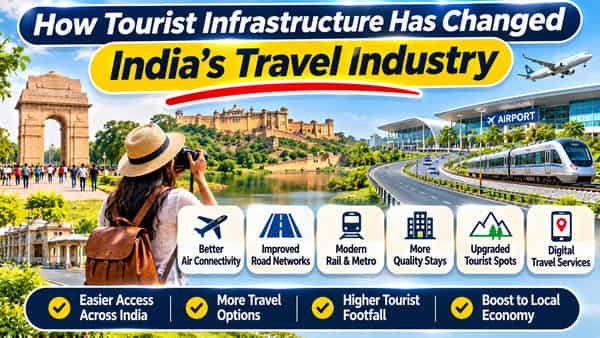
For India’s travel industry, improved infrastructure has done more than make existing destinations easier to reach. It has helped bring lesser-known places onto tourist itineraries, encouraged weekend travel, supported hospitality businesses and changed what Indian travellers expect from a holiday. At the same time, rapidly growing tourism creates new challenges involving congestion, waste, water use and pressure on sensitive destinations.
Tourist Infrastructure and Its Impact: Quick Overview
| Infrastructure Area | Impact on Travel |
|---|---|
| Airports | Faster access to more regions |
| Highways | Easier road trips and weekend travel |
| Railways | Improved intercity connectivity |
| Hotels | More accommodation across price segments |
| Digital Booking | Easier trip planning and comparison |
| Digital Payments | More convenient transactions |
| Mobile Internet | Navigation and real-time information |
| Local Transport | Easier movement within destinations |
| Sanitation | Better visitor comfort |
| Signage | Easier navigation |
| Wayside Facilities | More convenient road journeys |
| Destination Development | New tourism circuits and attractions |
Better Roads Have Expanded Road Tourism
Road infrastructure is one of the most important elements of domestic tourism.
For many Indian families, the holiday begins in their own car rather than at an airport.
Improved highways, expressways and connecting roads can reduce travel time between major cities and tourism centres. This has made short road trips more practical.
A destination that once felt too far away for a weekend can become accessible when journey times improve.
Better road connectivity supports:
- Weekend tourism
- Self-drive holidays
- Family road trips
- Religious tourism
- Rural tourism
- Hotel and restaurant businesses
- Local taxi services
Roadside infrastructure also matters.
Fuel stations, rest areas, clean toilets, restaurants, parking and emergency services can significantly influence the quality of a long-distance journey.
However, the final few kilometres remain important. A destination may have an excellent highway nearby but still suffer from poor local access roads.
Airports Have Changed the Geography of Tourism
Air connectivity can completely change how tourists perceive distance.
A destination requiring 15 hours by road or rail may become suitable for a long weekend when convenient air connections are available.
Expansion and improvement of airports outside the largest metropolitan cities has helped travellers access more regions without always depending on major aviation hubs.
Improved air connectivity can support:
- Leisure tourism
- Business travel
- Destination weddings
- Weekend breaks
- Medical tourism
- Regional hospitality businesses
It can also encourage hotels, restaurants, taxis and tour operators to invest in previously less-accessible markets.
However, having an airport does not automatically create a successful tourism destination. Reliable transport from the airport to hotels and attractions remains essential.
Railways Continue to Be Central to Indian Tourism
For millions of travellers, rail remains one of the most practical ways to explore India.
Rail connectivity is especially important for:
- Families
- Students
- Budget travellers
- Pilgrims
- Solo tourists
- Large groups
Online reservations have made planning significantly easier compared with relying entirely on physical booking counters.
Improved stations, better passenger information and stronger connections between cities can also improve the overall visitor experience.
Rail tourism is particularly valuable because stations often bring travellers much closer to city centres than airports.
At the same time, high demand during festivals, school holidays and long weekends means advance planning remains important on popular routes.
Online Booking Has Made Travel More Independent
One of the biggest transformations in Indian tourism has happened on the smartphone.
Travellers can now independently compare and arrange:
- Flights
- Trains
- Buses
- Hotels
- Homestays
- Rental vehicles
- Attraction tickets
- Tours
- Travel insurance
This has reduced dependence on traditional travel agents for straightforward trips.
It has also increased transparency.
A traveller can compare room photographs, location, amenities and guest feedback before choosing accommodation.
For small hotels and homestays, online visibility can create access to customers from across India.
However, travellers should still verify important details directly when necessary because photographs, descriptions and availability information may not always reflect current conditions.
Digital Payments Have Made Travel More Convenient
India’s rapid adoption of digital payments has had a major practical effect on domestic travel.
Travellers can increasingly pay digitally for:
- Restaurants
- Taxis
- Shops
- Hotels
- Tickets
- Local services
This reduces the need to carry large amounts of cash.
Digital payments can be particularly convenient when travelling between cities because visitors do not need to constantly search for ATMs.
However, tourists should not become completely dependent on one payment method.
Remote destinations may experience:
- Weak mobile networks
- Power interruptions
- Temporary payment failures
- Limited digital acceptance
Carrying some cash and having more than one payment option remains sensible.
Mobile Internet Has Changed How Tourists Explore
Smartphones have replaced several traditional travel tools.
Maps, guidebooks, phrase notes, hotel addresses and tickets can now exist on one device.
Mobile connectivity allows travellers to:
- Navigate unfamiliar cities
- Find nearby restaurants
- Check attraction timings
- Book taxis
- Translate information
- Contact accommodation
- Make payments
- Share locations
- Check weather
This has made independent travel much easier.
A tourist can arrive in a city without knowing every street in advance and still navigate confidently.
But mobile coverage is not equally reliable everywhere.
For remote mountains, forests and rural areas, downloading offline maps and keeping essential information available without internet access can still be useful.
Accommodation Has Become More Diverse
Tourist accommodation in India is no longer limited to conventional hotels and government guesthouses.
Travellers can choose from:
- Budget hotels
- Hostels
- Homestays
- Boutique hotels
- Resorts
- Serviced apartments
- Heritage properties
- Luxury hotels
This variety has helped tourism serve different budgets and travel styles.
A backpacker may prefer a hostel, while a family might choose a resort. Someone interested in culture may select a heritage property or local homestay.
The growth of alternative accommodation has also allowed tourism spending to reach smaller communities.
Quality, safety and regulatory standards can vary, however, so travellers should evaluate properties carefully rather than relying only on price.
Better Infrastructure Has Helped Lesser-Known Destinations
Tourism does not develop only because a place is beautiful.
People must be able to reach it, stay there, eat comfortably and move around safely.
When roads, internet connectivity and accommodation improve, lesser-known destinations can begin appearing on mainstream travel itineraries.
This can create economic opportunities for:
- Homestay owners
- Local guides
- Drivers
- Restaurants
- Handicraft sellers
- Adventure operators
- Farmers supplying tourism businesses
Tourism can therefore spread economic activity beyond major cities.
But rapid popularity can also overwhelm destinations that were never designed for large visitor numbers.
Infrastructure development needs to keep pace with tourism growth.
Public Toilets and Sanitation Matter More Than They Receive Credit For
Tourism infrastructure is not only about airports and luxury hotels.
Simple facilities can determine whether a destination feels comfortable.
Visitors need:
- Clean public toilets
- Drinking-water facilities
- Waste bins
- Proper drainage
- Safe pedestrian areas
- Parking
- Clear signage
These facilities become particularly important for families with children, elderly travellers and long road journeys.
A spectacular tourist attraction can still leave a poor impression if basic visitor facilities are missing.
Signage and Tourist Information Improve Accessibility
Good signage reduces confusion.
Visitors should be able to identify:
- Attraction entrances
- Parking areas
- Toilets
- Ticket counters
- Emergency exits
- Public transport
- Walking routes
Multilingual or clearly designed signs can be particularly useful at destinations receiving visitors from different parts of India and abroad.
Digital information can complement physical signs, but it should not completely replace them because tourists may not always have mobile connectivity.
Infrastructure Has Encouraged Shorter, More Frequent Trips
Improved connectivity has changed not only where Indians travel but also how often they travel.
A holiday no longer has to be one long annual trip.
Urban travellers increasingly consider:
- Weekend getaways
- Long-weekend trips
- Short road trips
- Workations
- Staycations
- Festival travel
When destinations become easier to access, short trips become practical.
This supports hotels and tourism businesses throughout more of the year rather than only during traditional holiday seasons.
Tourism Growth Can Create Infrastructure Problems Too
Better connectivity can sometimes produce a new problem: too many visitors arriving faster than a destination can handle them.
Popular hill stations, beaches and pilgrimage centres may experience:
- Traffic congestion
- Parking shortages
- Waste accumulation
- Water pressure
- Unplanned construction
- Noise
- Pressure on natural areas
Building a better road can increase tourist numbers, but that road alone cannot solve waste management or water demand.
Sustainable tourism therefore requires infrastructure for both bringing visitors in and managing their impact.
The Next Stage Is Smarter Destination Management
The future of Indian tourism infrastructure is not simply about constructing more facilities.
Quality matters.
A well-managed destination needs coordination between:
- Transport
- Accommodation
- Waste management
- Water supply
- Local businesses
- Safety services
- Digital information
- Environmental protection
Accessibility should also receive greater attention so that travellers with disabilities, elderly visitors and families with young children can experience destinations more comfortably.
Tourist infrastructure works best when travellers barely notice it. Roads connect smoothly, signs are clear, toilets are available, payments work and accommodation is easy to find.
When these systems function together, tourists can spend less time solving logistical problems and more time experiencing the destination itself.
FAQs
Q1. How does better infrastructure increase tourism in smaller cities?
A. Improved roads, railways, airports, accommodation and digital connectivity reduce the difficulty of reaching and staying in smaller destinations. This can encourage tourists to explore beyond established circuits and support local hospitality businesses.
Q2. Has technology reduced the need for travel agents in India?
A. Technology has made independent booking much easier, but travel agents remain useful for complex itineraries, large groups, specialised tours and travellers who prefer professional assistance. Digital platforms have mainly expanded the number of ways people can plan trips.
Q3. Can too much tourism infrastructure damage a destination?
A. Poorly planned development can create environmental and social pressure through construction, congestion, waste and increased demand for water and energy. Infrastructure should therefore be designed according to the destination’s capacity and environmental conditions.
Q4. What infrastructure matters most to ordinary tourists?
A. Reliable transport, safe accommodation, clean toilets, drinking water, mobile connectivity, clear signage, local transport and access to emergency assistance are among the most practical requirements. Expensive attractions cannot compensate for weak basic facilities.