Hot-water plumbing is one part of a home where choosing the right pipe deserves extra attention. A pipe installed behind bathroom tiles or inside a wall may carry hot water from a geyser every day for years. If the material, joints or installation are unsuitable, repairing a future leak can mean breaking expensive tiles, opening walls and temporarily shutting down the water supply.
For Indian homes, PPR and CPVC are two popular options for hot-water lines. CPVC is widely used in residential plumbing and is joined using compatible solvent cement. PPR uses heat-fusion joining, in which the pipe and fitting surfaces are heated and fused together.
Both materials can work effectively for hot and cold water when the correct product is selected and installed according to its specifications. The better choice depends on water temperature, pressure, installation skill, availability of fittings, project size, maintenance expectations and budget.
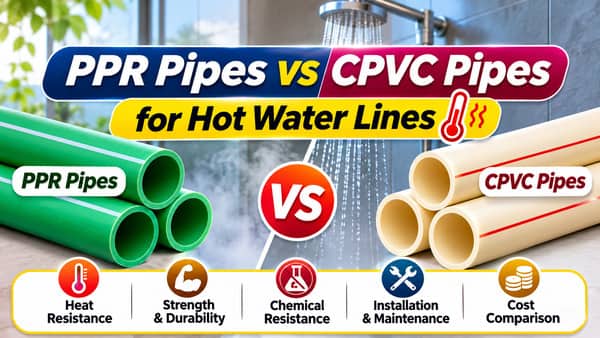
PPR vs CPVC Pipes: Quick Comparison
| Factor | PPR Pipes | CPVC Pipes |
|---|---|---|
| Material | Polypropylene Random Copolymer | Chlorinated Polyvinyl Chloride |
| Hot-Water Use | Suitable with correct rating | Suitable with correct rating |
| Joining Method | Heat fusion | Solvent-cement joining |
| Corrosion Resistance | Excellent | Excellent |
| Installation Equipment | Fusion machine required | Relatively simple tools |
| Installation Skill | Proper fusion technique essential | Proper joint preparation essential |
| Pipe Flexibility | Relatively flexible | More rigid |
| Thermal Expansion | Requires consideration | Requires consideration |
| Typical Home Use | Hot/cold plumbing and larger networks | Hot/cold residential plumbing |
| Repair | Requires suitable fusion tools/fittings | Often convenient with correct fittings and solvent system |
What Are PPR Pipes?
PPR stands for Polypropylene Random Copolymer. It is a plastic piping material used for hot and cold water distribution in residential, commercial and other building applications.
One of its most distinctive characteristics is its joining method.
Instead of relying on threaded connections or solvent cement for ordinary pipe-to-fitting joints, PPR systems commonly use heat fusion.
During installation, the outer surface of the pipe and inner surface of the fitting are heated using a fusion tool. The softened components are then joined and allowed to cool, creating an integrated connection when the procedure is performed correctly.
PPR is commonly considered for:
- Hot-water lines
- Cold-water distribution
- Bathrooms
- Kitchens
- Central hot-water systems
- Apartments
- Hotels and commercial properties
Different PPR classes and specifications are available, so the exact product must match the application’s pressure and temperature requirements.
What Are CPVC Pipes?
CPVC stands for Chlorinated Polyvinyl Chloride.
It is widely used in Indian residential plumbing because it can carry both hot and cold water within its specified operating limits.
CPVC pipes are typically joined using a compatible solvent-cement system.
During proper joining, the pipe and fitting surfaces are prepared and connected using the specified solvent cement, which creates the joint after appropriate curing.
CPVC is commonly used for:
- Geyser hot-water lines
- Bathroom plumbing
- Kitchen water supply
- Hot and cold water distribution
- Apartments and independent houses
Its widespread use also means CPVC pipes and fittings are generally familiar to many residential plumbers.
Which Handles Hot Water Better?
Both properly specified PPR and CPVC systems can be suitable for hot-water plumbing.
There is no meaningful answer such as “all PPR handles more heat” or “all CPVC is better for geysers” without examining the actual product specifications.
Temperature capability depends on:
- Pipe grade
- Pressure class
- Manufacturer
- Operating pressure
- Continuous water temperature
- Expected service conditions
Pressure and temperature must also be considered together.
A pipe’s allowable operating pressure can change as water temperature increases.
Therefore, when planning a hot-water line, ask for the manufacturer’s pressure-temperature performance data rather than choosing only by pipe diameter.
The Biggest Difference: How the Joints Are Made
For many projects, the joining method is the most practical difference between PPR and CPVC.
PPR Heat-Fusion Joints
PPR pipes and fittings are normally joined using a fusion machine.
When done correctly, the heated pipe and fitting surfaces fuse together to form a strong connection.
Potential advantages include:
- No solvent cement for ordinary fusion joints
- Integrated pipe-and-fitting connection
- Suitable for extensive plumbing networks
- Reliable joints when installation is correct
However, workmanship is critical.
Overheating, underheating, incorrect insertion depth, misalignment or excessive material inside the fitting can compromise the joint or restrict water flow.
CPVC Solvent-Cement Joints
CPVC systems generally use compatible solvent cement.
The process is relatively straightforward, but correct preparation and curing are essential.
Problems can occur when plumbers:
- Use incompatible cement
- Apply excessive or insufficient material
- Join dirty surfaces
- Fail to insert fittings properly
- Pressurise the system before adequate curing
Neither joining system compensates for poor workmanship.
Which Has Better Corrosion Resistance?
Both PPR and CPVC offer excellent resistance to conventional rust because they are non-metallic materials.
This is a major advantage over certain traditional metal plumbing systems.
Potential benefits include:
- No conventional internal rust
- Smooth internal surfaces
- Good resistance to many water conditions
- Reduced dependence on protective metal coatings
However, water chemistry still matters.
Plumbing systems contain more than pipes. Valves, taps, connectors, water heaters and transition fittings may contain metals that react differently to local water conditions.
Therefore, overall system design remains important.
Thermal Expansion in Hot-Water Lines
Plastic pipes expand when heated and contract as they cool.
This is particularly relevant for long hot-water runs.
If thermal movement is ignored, pipes may experience unnecessary stress, bending, noise or pressure on fittings and supports.
PPR generally requires careful consideration of thermal expansion, particularly across long straight runs.
CPVC also expands with temperature and needs appropriate installation allowances.
Good plumbing design may involve:
- Correct support spacing
- Movement allowances
- Expansion loops where necessary
- Suitable routing
- Following manufacturer instructions
Pipes should not simply be rigidly trapped inside a wall without considering temperature-related movement.
Which Is Easier to Install?
CPVC often has an advantage in small residential projects because the installation process requires relatively simple tools and is familiar to many plumbers.
This can make it convenient for:
- Individual bathrooms
- Small renovations
- Kitchen upgrades
- Independent houses
PPR installation requires a suitable fusion machine and an installer who knows how to use it correctly.
Once the team is trained and equipped, PPR can be efficient for larger networks with many joints.
Therefore, installer competence can be more important than theoretical material advantages.
A perfectly specified PPR system installed incorrectly may perform worse than a properly installed CPVC system, and vice versa.
Which Is Better for Concealed Plumbing?
Both can be used for concealed hot-water plumbing when properly designed and installed.
Because concealed leaks are expensive to repair, homeowners should focus on the entire installation process.
Before covering the pipes:
- Check every joint.
- Confirm correct pipe specifications.
- Verify fittings are from a compatible system.
- Conduct the recommended pressure test.
- Check hot and cold pipe routing.
- Photograph concealed plumbing locations.
- Ensure pipes are protected from accidental drilling or damage.
Never rush to install tiles or close wall channels before testing the plumbing network.
PPR vs CPVC for Geyser Connections
Both materials can be suitable for hot-water distribution from a geyser when their rated limits and installation requirements are followed.
However, the connection immediately around the water heater may have specific requirements.
Homeowners should check:
- Geyser manufacturer’s installation instructions
- Recommended connection materials
- Temperature and pressure relief arrangements
- Required valves
- Pipe temperature rating
- Local plumbing requirements
Do not assume that a plastic pipe can be connected in any configuration simply because it is labelled for hot water.
The water heater and piping should be treated as one coordinated system.
Which Is Better for Large Homes?
PPR can be attractive for large plumbing networks where trained fusion installers are available.
It is often considered for:
- Large villas
- Multi-bathroom houses
- Hotels
- Apartment projects
- Centralised hot-water networks
- Commercial properties
CPVC remains highly practical for ordinary houses and apartments because of its availability, familiar installation process and wide range of fittings.
For a large project, decisions should ideally be based on hydraulic design and system specifications rather than plumber preference alone.
Maintenance and Repairs
CPVC can be convenient for residential repairs because many plumbers are familiar with the material and compatible components are widely available in many Indian markets.
PPR repairs require appropriate fusion equipment and compatible fittings.
This does not necessarily make PPR difficult to repair, but it means having access to a technician equipped for the system is important.
Before choosing either material, ask yourself:
Will qualified service and genuine fittings be easily available in my area five or ten years later?
That practical question is especially important outside major cities.
Cost: PPR or CPVC?
There is no universal winner on price.
Total cost depends on:
- Pipe brand
- Diameter
- Pressure class
- Fittings
- Number of joints
- Labour
- Installation equipment
- Project size
- Insulation
- Local availability
PPR may involve additional fusion equipment and specialised labour, while CPVC requires compatible solvent cement and fittings.
For concealed hot-water lines, choosing purely on the cheapest quotation can be risky.
A slightly higher initial investment in quality materials and skilled installation may be far less expensive than repairing a hidden leak later.
Common Mistakes to Avoid
Whether you select PPR or CPVC, avoid:
- Buying pipes without checking ratings
- Using incompatible fittings
- Ignoring hot-water pressure
- Employing untrained installers
- Incorrect PPR fusion
- Using unsuitable CPVC solvent cement
- Ignoring thermal expansion
- Concealing pipes without pressure testing
- Mixing systems without approved transition fittings
- Selecting products only by price
Also retain invoices and product information in case warranty support is needed later.
PPR or CPVC: Which Should You Choose?
Consider PPR when:
- Skilled fusion installers are available.
- You are planning an extensive plumbing network.
- You prefer heat-fused joints.
- The selected product meets your temperature and pressure requirements.
- Long hot-water runs are properly designed for thermal movement.
Consider CPVC when:
- You want a widely used residential hot-and-cold plumbing system.
- Local plumbers have strong experience with CPVC.
- Fittings and repair materials are readily available.
- The system meets your hot-water pressure and temperature requirements.
- You are working on a typical apartment, bathroom or house renovation.
For most homeowners, the better choice is not simply PPR or CPVC. It is the correctly rated, genuine piping system installed by someone experienced with that particular material.
FAQs
Q1. Is PPR better than CPVC for geyser hot-water lines?
A. Both can be suitable when the selected pipe is correctly rated for the geyser’s operating temperature and pressure. PPR uses heat-fused joints, while CPVC commonly uses solvent-cement joints. Installation quality and manufacturer specifications should guide the decision.
Q2. Can PPR and CPVC pipes be connected together?
A. They should not be directly joined using ordinary PPR fusion or CPVC solvent cement. Where a transition between different piping materials is necessary, use suitable manufacturer-approved transition fittings and proper installation procedures.
Q3. Which is better for concealed bathroom plumbing?
A. Both materials can be used successfully for concealed plumbing. More important than the material alone are genuine pipes and fittings, correct joint preparation, pressure-temperature ratings, thermal-expansion allowances and pressure testing before tiles or walls are finished.
Q4. Should hot-water pipes be insulated?
A. Insulation can be beneficial, particularly for longer hot-water lines. It can reduce heat loss, help hot water remain warmer while travelling from the heater to the tap and improve system efficiency. The appropriate insulation should be compatible with the piping system and installation conditions.