Most plumbing pipes disappear behind walls, ceilings and floors once a house is completed, but the material you choose can affect your home for years. A poor choice may result in leakage, corrosion, pressure problems or expensive repairs that require breaking tiles and reopening finished walls. This is why choosing between copper pipes and PVC pipes should be based on the actual plumbing application rather than simply comparing prices.
Copper has a long history in plumbing and is valued for strength, heat resistance and a relatively compact profile. PVC, or polyvinyl chloride, is lightweight, corrosion-resistant and widely used in India for applications such as drainage, rainwater systems, irrigation and suitable cold-water services.
Neither material is universally better. Copper can handle conditions that conventional PVC cannot, while PVC can offer a practical and economical solution where its specifications match the application. A closer comparison of their properties, costs and limitations can help Indian homeowners make a more informed choice.
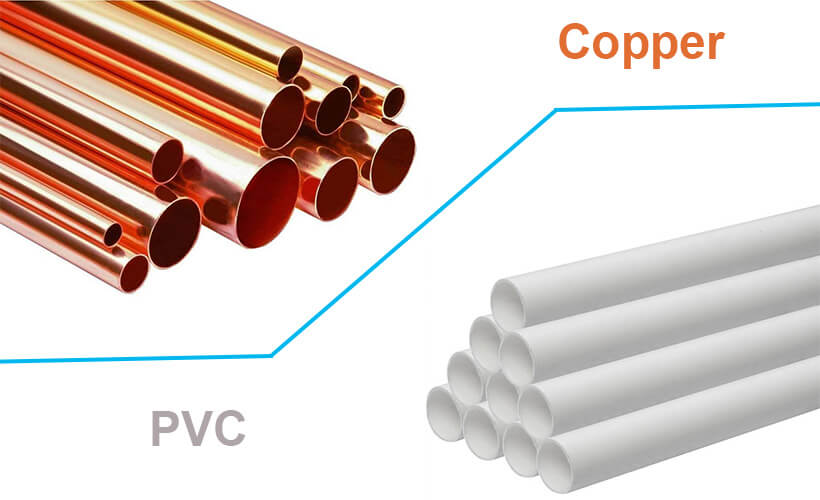
Copper Pipes vs PVC Pipes: Quick Comparison
| Factor | Copper Pipes | PVC Pipes |
|---|---|---|
| Material | Metal | Plastic |
| Hot-Water Suitability | Suitable with correct specification | Conventional PVC generally not preferred |
| Cold-Water Use | Suitable | Suitable when product is approved for application |
| Corrosion | Can be affected by certain water conditions | Does not rust |
| Weight | Heavier | Lightweight |
| Installation | Requires appropriate tools and skill | Relatively simple |
| Material Cost | Generally higher | Generally lower |
| Structural Rigidity | High | Lower than copper |
| Drainage Use | Possible but generally uneconomical | Very common |
| Typical Home Application | Water supply, specialised plumbing | Drainage, rainwater, irrigation, suitable cold-water systems |
What Are Copper Pipes?
Copper is a metallic piping material that has been used internationally in water-supply and building-services systems for decades.
It is available in different types, wall thicknesses and sizes depending on the intended application.
Copper pipes can be used in areas such as:
- Hot-water distribution
- Cold-water supply
- HVAC and refrigeration systems with appropriate grades
- Certain gas or specialised building services where specifically approved
One of copper’s major strengths is its ability to tolerate higher temperatures compared with conventional PVC.
However, copper is relatively expensive, and correct installation requires trained workers and appropriate joining methods.
What Are PVC Pipes?
PVC stands for Polyvinyl Chloride. It is one of the most familiar plastic piping materials used in Indian buildings.
Different PVC systems are manufactured for different applications.
Depending on the specific product, PVC can be used for:
- Cold-water distribution
- Drainage
- Soil and waste lines
- Rainwater pipes
- Irrigation
- Vent systems
- Underground piping
PVC is popular because it is lightweight, economical and resistant to conventional rust.
However, standard PVC should not be confused with CPVC. CPVC is chemically modified to handle higher temperatures and is commonly used for hot and cold water plumbing.
Which Is Better for Hot Water?
For this comparison, copper has a clear advantage over conventional PVC.
Copper can withstand substantially higher temperatures when the correct pipe and joint system are used.
Standard PVC has lower temperature limits and is generally not selected for domestic hot-water distribution.
Therefore, conventional PVC should not normally be used directly for hot-water lines from:
- Geysers
- Water heaters
- Hot showers
- Hot-water kitchen taps
For plastic hot-water plumbing, materials such as appropriately rated CPVC or PPR are commonly considered instead.
Always follow the pipe manufacturer’s temperature and pressure ratings.
Copper vs PVC for Cold Water
Both materials can be used for cold-water applications when the selected product is approved for the intended purpose.
Copper provides a rigid and durable water-supply network but comes at a higher material and installation cost.
PVC can be much more economical and easier to handle.
However, not every white or grey PVC pipe available in a hardware shop is automatically suitable for potable pressurised water.
Before using PVC for a water-supply line, check:
- Applicable product standard
- Pressure class
- Pipe diameter
- Manufacturer
- Intended application
- Potable-water suitability where relevant
The pipe should be selected according to the plumbing design rather than appearance alone.
Which Pipe Is More Durable?
Copper has excellent mechanical strength and can provide a long service life when correctly installed in suitable water conditions.
It handles heat effectively and does not become brittle simply because it is exposed to normal hot-water temperatures within its design limits.
However, copper is not completely immune to deterioration.
Certain water chemistry, installation conditions or external environments can contribute to corrosion or pinhole leaks.
PVC does not rust and offers excellent resistance to many forms of chemical corrosion.
But it has other limitations.
PVC can be affected by:
- Excessive heat
- Prolonged UV exposure where unsuitable
- Heavy impact
- Incorrect solvent joints
- Excessive pressure
- Poor installation
Therefore, longevity depends on whether the material is being used within its intended operating conditions.
Corrosion: PVC Has an Important Advantage
PVC’s resistance to conventional metallic corrosion is one of its strongest benefits.
It does not develop rust in the way ferrous metal pipes can.
Copper also does not rust like iron, but it can undergo corrosion under certain conditions.
Factors potentially influencing copper corrosion include:
- Water chemistry
- Water velocity
- Installation workmanship
- Contact with incompatible materials
- External chemical exposure
This does not mean copper is unreliable. Properly designed copper plumbing can last for many years.
It simply means that “metal” should not automatically be interpreted as permanent or maintenance-free.
Which Pipe Handles Pressure Better?
It is tempting to say copper because it is metal, but pipe pressure capability should always be judged from the specific product rating.
Copper pipes come in different wall thicknesses and specifications.
PVC pipes are also manufactured in different pressure classes.
A correctly specified pressure-rated PVC pipe can handle substantial cold-water pressure within its operating limits.
Temperature is important too.
Plastic pipe pressure capability can reduce as temperature increases, which is another reason conventional PVC should not be used outside its approved temperature range.
For houses using powerful pumps or pressure systems, ask the plumber to calculate operating pressure rather than choosing a pipe based only on diameter.
Installation: Which Is Easier?
PVC is generally easier to transport and handle because it is lightweight.
PVC joints commonly use compatible solvent-cement systems.
Correct installation requires:
- Clean, square cuts
- Proper preparation
- Correct fittings
- Compatible solvent cement
- Adequate curing time
- Appropriate pipe support
Copper installation requires different skills and may involve soldering, brazing, compression fittings or other approved connection methods depending on the system.
The work often requires more specialised tools and labour.
Therefore, PVC can have a practical advantage for projects where simplicity and installation speed are priorities.
Which Is Better for Concealed Plumbing?
Both materials can be concealed when they are appropriate for the application and installed correctly.
However, concealed plumbing requires extra care because a small leak can damage:
- Wall finishes
- Paint
- Tiles
- Cabinets
- False ceilings
- Electrical installations
Before closing walls, homeowners should ensure:
- All joints are inspected.
- Pipes are properly supported.
- Correct fittings have been used.
- The system is pressure-tested.
- Pipe routes are photographed.
- Potential drilling zones are documented.
For concealed water lines, material quality and installation workmanship should never be sacrificed simply to reduce the initial cost.
Copper vs PVC for Drinking Water
For drinking-water supply, use only piping products specifically intended and approved for potable-water applications.
Do not assume every copper or PVC product is automatically suitable.
With copper, local water chemistry can be relevant to long-term performance.
With PVC, the exact grade and certification matter.
A useful purchasing checklist includes:
- Reputed manufacturer
- Clear product markings
- Relevant standards
- Potable-water approval where required
- Correct pressure rating
- Genuine compatible fittings
Avoid unbranded pipes for concealed potable-water systems merely because they are significantly cheaper.
Which Is Better for Drainage?
PVC is the clear practical choice for most normal residential drainage applications between these two materials.
PVC soil, waste and drainage systems are widely used because they are:
- Lightweight
- Corrosion-resistant
- Economical
- Easy to cut and install
- Available in many sizes and fittings
- Suitable for common residential drainage requirements when correctly specified
Using copper for ordinary wastewater or rainwater drainage would generally be unnecessarily expensive.
This demonstrates an important point: the best plumbing material depends on the job.
A material that performs exceptionally in one application may make little financial sense in another.
Noise Considerations
Water flowing through pipes can create noise, particularly in drainage systems or when pipes are poorly supported.
Copper’s rigid metallic construction can transmit plumbing noise through building structures if not properly isolated.
PVC systems can also generate noticeable flow noise, especially in vertical waste stacks.
Noise control can depend on:
- Pipe diameter
- Water velocity
- Pipe supports
- Wall construction
- Insulation
- Drainage layout
If plumbing noise is important, ask about acoustic treatment rather than relying solely on pipe material.
Cost: Copper vs PVC
Copper is generally substantially more expensive than PVC.
Its total installed cost can also be higher because of labour, fittings and specialised installation.
PVC is popular partly because it provides economical plumbing for many applications.
But the cheapest initial system is not necessarily the lowest-cost solution over the life of the house.
Compare:
- Material cost
- Fitting cost
- Labour
- Expected maintenance
- Suitability for temperature and pressure
- Repair accessibility
- Expected service conditions
Installing inexpensive PVC in an application for which it is not rated can ultimately cost far more than selecting the correct material from the beginning.
Environmental and Recycling Considerations
Copper has a significant advantage in recyclability. It has established recycling value and can be recovered and reused.
PVC is also recyclable under appropriate systems, but actual recycling depends on local collection and processing infrastructure.
Environmental comparisons are complex because they involve manufacturing, transport, service life and end-of-life recovery.
For homeowners, selecting a durable system that avoids premature replacement is an important practical consideration regardless of material.
Common Mistakes to Avoid
When comparing copper and PVC, avoid:
- Using conventional PVC for hot-water lines
- Assuming every PVC pipe is suitable for drinking water
- Choosing pipe only by price
- Ignoring pressure ratings
- Ignoring water chemistry with copper
- Using incompatible fittings or joint materials
- Concealing plumbing before testing
- Leaving unsuitable PVC exposed to prolonged sunlight
- Assuming copper can never corrode
- Using untrained workers for critical joints
The complete plumbing system should be planned before tiles, flooring and cabinetry make future access difficult.
Which Should You Choose?
Choose copper pipes when:
- Higher-temperature performance is required.
- The project specifically calls for copper.
- Appropriate skilled installers are available.
- Higher initial cost is acceptable.
- The selected copper system suits local water conditions.
Choose PVC pipes when:
- The application is within the pipe’s temperature and pressure rating.
- You need economical drainage or rainwater piping.
- A suitable PVC system is specified for cold-water use.
- Lightweight and easy installation are priorities.
For most Indian homes, copper and PVC are not direct replacements for every application. Instead of asking which material is universally superior, determine what the pipe needs to carry, at what temperature and pressure, and under what installation conditions.
FAQs
1. Can PVC replace copper for hot-water plumbing?
A. Conventional PVC is generally not suitable for domestic hot-water distribution. If a plastic hot-water system is required, appropriately rated CPVC, PPR or another approved material may be considered depending on the project.
2. Which is better for bathroom plumbing, copper or PVC?
A. It depends on the line. Copper can carry suitable hot and cold water, while appropriate PVC products may be used for drainage and certain cold-water applications. A bathroom can therefore use different pipe materials for water supply and wastewater.
3. Does copper pipe last longer than PVC?
A. Both can provide long service lives when used correctly. Copper is strong and heat-resistant but can be affected by certain water or environmental conditions. PVC resists rust but must remain within its temperature, pressure and exposure limits.
4. Which is cheaper for an Indian home?
A. PVC is generally much cheaper in material and installation cost. However, price should be compared only between pipes suitable for the same application. Using an inexpensive material outside its rated conditions can result in costly repairs later.