Imagine you have found a product category you believe can become a successful business—clothing, footwear, cosmetics, home décor, electronics accessories or speciality foods. The next decision can shape almost everything that follows: should you rent a shop in a good market and sell directly to customers, or build an online store and deliver orders across India?
An online store can potentially reach customers far beyond your local area and may require less investment in commercial space. A physical store, however, gives customers the opportunity to see, touch, try and immediately purchase products, which can be extremely valuable in categories where trust and physical experience influence buying decisions.
For Indian entrepreneurs, there is no universal winner. The better model depends on the product, location, target customer, available capital, margins, delivery requirements and your ability to attract customers. Before investing, it is important to compare the complete economics of both models rather than assuming that online automatically means cheap or offline automatically means outdated.
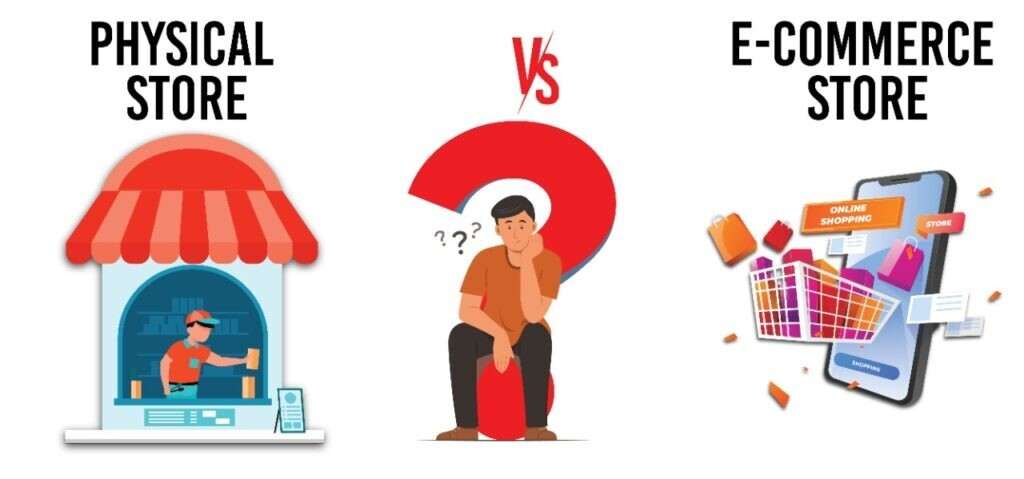
Online Store Vs Physical Store: Quick Comparison
| Factor | Online Store | Physical Store |
|---|---|---|
| Initial Investment | Usually lower | Usually higher |
| Geographic Reach | Potentially very wide | Mainly local |
| Commercial Rent | Usually not required for storefront | Major expense in many locations |
| Customer Experience | Digital | Physical and direct |
| Product Trial | Limited | Easy |
| Opening Hours | Orders can be placed 24/7 | Fixed business hours |
| Marketing | SEO, social, ads, marketplaces | Location, signage, local promotion |
| Delivery | Usually required | Customer can take product immediately |
| Trust Building | Reviews, content, policies | Face-to-face interaction |
| Scaling | Relatively flexible | Requires additional locations/capacity |
| Returns | Can be operationally complex | Often easier to inspect |
| Best For | Wider reach and digital-first businesses | Local demand and experience-led products |
Starting an Online Store Usually Requires Less Physical Infrastructure
One of the biggest advantages of an online business is that you may not need an expensive customer-facing retail location.
A basic online operation may require:
- Website or marketplace presence
- Product inventory
- Packaging
- Payment system
- Storage
- Courier arrangements
- Digital marketing
A physical store may additionally require:
- Security deposit
- Monthly rent
- Interiors
- Display furniture
- Signage
- Lighting
- Utilities
- Store employees
These costs can make physical retail expensive, particularly in premium commercial areas.
However, online stores have their own costs. Website development, marketplace fees, advertising, shipping, returns and customer acquisition can become significant.
Online does not mean free.
A Physical Store Benefits From Location
In offline retail, location can become one of the strongest customer-acquisition tools.
A well-positioned shop can receive customers simply because people walk or drive past it.
Good locations may benefit from:
- High footfall
- Nearby residential areas
- Offices
- Metro or transport access
- Complementary businesses
- Established markets
But strong locations generally come at a price.
A cheaper shop in an area with little relevant footfall can ultimately be more expensive if it generates insufficient sales.
Before renting, entrepreneurs should study the location at different times and days rather than relying only on a broker’s description.
Online Stores Can Reach Customers Across India
A physical shop is naturally limited by geography.
Most customers need to travel to the location.
An online store can potentially sell from Delhi to customers in Bengaluru, Pune, Jaipur, Kochi or many other cities without opening branches there.
This makes online retail attractive for niche products.
Suppose you sell a highly specialised product that only a small percentage of people want. A local neighbourhood may not contain enough potential customers.
Online selling can combine demand from multiple locations.
However, national reach also means competing with sellers from across the country.
Your market becomes larger, but so does your competition.
Physical Stores Offer a Stronger Product Experience
Some products are easier to sell when customers can physically examine them.
Examples include:
- Clothing
- Footwear
- Furniture
- Jewellery
- Cosmetics
- Home décor
Customers may want to check:
- Size
- Colour
- Texture
- Comfort
- Material
- Build quality
Physical stores allow immediate evaluation.
A salesperson can also answer questions and recommend alternatives.
Online businesses need to replace this physical interaction with detailed photographs, videos, size charts, descriptions, reviews and responsive customer support.
The better the product information, the lower the uncertainty for the buyer.
Trust Works Differently Online and Offline
A customer entering an established shop can see the products, employees and business location.
That physical presence can create immediate confidence.
New online stores have to build trust digitally.
Useful trust signals include:
- Clear product information
- Genuine customer reviews
- Transparent return policies
- Secure payment options
- Visible contact information
- Reliable delivery
- Responsive support
A poorly designed website with unclear policies can make customers hesitate even if the products are excellent.
Trust is particularly important when customers are being asked to pay before receiving the product.
Online Marketing Can Become Expensive
A common misconception is that launching a website automatically creates customers.
A new online store may initially have almost no visitors.
Businesses often need to invest in:
- Search engine optimisation
- Social media
- Influencer marketing
- Paid advertising
- Email marketing
- Content creation
- Marketplace promotion
Digital advertising can quickly reduce margins if customer acquisition costs are high.
For example, earning ₹500 gross margin on a product is not attractive if advertising costs ₹400 to acquire each customer before shipping and returns are considered.
Online businesses must understand customer acquisition cost, not just sales revenue.
Physical Stores Have High Fixed Costs
The financial challenge with physical retail is that many expenses continue even during slow months.
A shop may still need to pay:
- Rent
- Salaries
- Electricity
- Maintenance
- Security
- Local marketing
This creates a higher break-even requirement.
If monthly fixed costs are ₹2 lakh and the average gross profit per sale is ₹1,000, the store needs substantial sales just to cover those expenses.
Entrepreneurs should calculate break-even sales before signing a long lease.
Delivery Is a Major Online Cost
Physical-store customers usually take the product immediately.
Online businesses need to move products from the seller to the customer.
Costs may include:
- Packaging
- Forward shipping
- Payment processing
- Return shipping
- Failed deliveries
- Customer support
Cash on Delivery can be useful in India but may increase the financial impact of failed deliveries or Return to Origin (RTO).
A business should calculate profit after shipping and returns rather than assuming every placed order equals a successful sale.
Inventory Management Matters in Both Models
Both online and offline businesses can lose money through poor inventory planning.
Too much inventory creates blocked capital.
Too little inventory creates lost sales.
Online businesses need accurate inventory information because customers may order products they cannot physically see.
Physical retailers must decide how much stock to display and how much to keep in storage.
Businesses should regularly identify:
- Fast-moving products
- Slow-moving products
- Seasonal items
- High-margin products
- Frequently returned products
Good inventory decisions can matter more to profitability than whether the store operates online or offline.
Online Stores Are Usually Easier to Scale Geographically
Opening another physical branch may require:
- New property
- Deposit
- Interiors
- Employees
- Inventory
- Local marketing
An online store can potentially increase sales without duplicating all of these expenses.
However, online scaling creates its own requirements.
More orders may require:
- Larger warehouses
- Better software
- More customer-support staff
- Stronger logistics
- Higher working capital
Digital businesses are scalable, but scaling is not effortless.
Physical Stores Can Build Strong Local Relationships
Offline retail has an advantage that is difficult to reproduce digitally: personal relationships.
A neighbourhood retailer may know:
- Regular customers
- Their preferences
- Common sizes
- Purchase history
- Local demand
This can create strong loyalty.
Customers may return because they trust the owner or staff rather than because the store offers the lowest price.
For businesses dependent on repeat local customers, this relationship can be extremely valuable.
An Omnichannel Model Can Offer the Best of Both
Businesses do not always have to choose only online or offline.
An omnichannel approach can combine both.
For example, a retailer might:
- Operate one physical showroom.
- Maintain an online store.
- Accept orders through digital channels.
- Allow store pickup where practical.
- Use social media to drive both online and offline sales.
The physical store creates trust and product experience, while the online channel extends reach.
A business can also start online, validate demand and later open a showroom. Alternatively, an established retailer can add e-commerce to reach customers beyond its neighbourhood.
Which Model Should You Start?
An online store may be more suitable if:
- Your starting capital is limited.
- Customers can evaluate the product digitally.
- Your target market is geographically dispersed.
- You understand digital marketing.
- Shipping is practical.
A physical store may be better if:
- Customers need to try or inspect products.
- You have access to a strong retail location.
- Local demand is proven.
- Personal service matters.
- Immediate purchase is important.
Before deciding, calculate the complete economics of both models.
Do not ask only, “Which one is cheaper to start?”
Ask, “Which model can acquire and serve my customers profitably?”
That question leads to a much stronger business decision.
FAQs
1. Can I start an online store without keeping inventory?
Certain fulfilment models, including dropshipping or supplier-led fulfilment, may allow this. However, you will have less control over stock, product quality, packaging and delivery, so reliable suppliers are essential.
2. How do I know whether a physical shop location is worth the rent?
Study relevant footfall, nearby competition, customer demographics, visibility, parking or transport access and expected sales. Calculate how many sales are required each month to cover rent and other fixed expenses before signing a lease.
3. Is selling through an online marketplace better than creating my own website?
Marketplaces can provide existing customer traffic but may involve fees, competition and platform rules. Your own website gives greater control over branding and customer relationships but requires you to generate traffic. Many sellers use both.
4. Should I start online first and open a physical store later?
This can be a practical strategy for some products. Online selling can help test demand before committing to commercial rent and interiors. If you develop a strong customer base in a particular city, a physical showroom can later provide additional trust and product experience.