A tap left running for just a little longer than necessary may not look like a major problem, but repeated several times a day across a household, it can add to unnecessary water consumption. This matters in India, where many cities and residential societies experience seasonal water shortages, dependence on tankers, falling groundwater levels or restrictions on daily water supply.
This is one reason sensor taps are increasingly being considered as an alternative to conventional manual taps. A sensor tap automatically starts water flow when it detects hands and stops when they are removed. A manual tap depends entirely on the user to open and close the water.
Sensor taps can reduce water wasted while hands are not actually under the outlet, but that does not mean every sensor tap automatically saves more water than every manual tap. Flow rate, sensor settings, aerators, user behaviour, maintenance and water pressure all affect actual consumption.
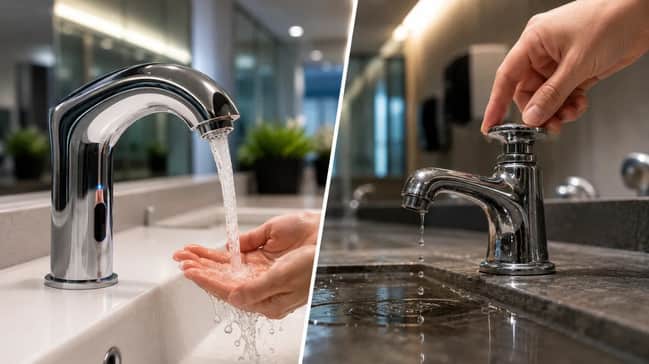
So, which option makes more sense for an Indian home? Here is a practical comparison.
Sensor Taps vs Manual Taps: Quick Comparison
| Factor | Sensor Taps | Manual Taps |
|---|---|---|
| Operation | Touch-free, automatic | Hand-operated |
| Water Shut-Off | Automatic | User-controlled |
| Water-Saving Potential | High when properly configured | Can be high with efficient use |
| Accidental Running | Lower | Possible |
| Hygiene | Less surface contact | Handles are touched regularly |
| Electricity | Battery or power supply usually required | Usually none |
| Maintenance | More components | Simpler |
| Initial Cost | Generally higher | Generally lower |
| Repair | May require specialised parts | Usually easier |
| Best Use | High-use basins, hygiene-focused spaces | Most household applications |
How Do Sensor Taps Work?
Sensor taps use an electronic sensor—commonly infrared—to detect when hands or an object are placed within the activation zone.
The system then operates a valve to release water. When the hands are removed, the valve closes automatically.
Depending on the model, sensor taps may operate through:
- Batteries
- Mains electricity
- A combination or backup arrangement
Some products also allow adjustments to sensor range, flow duration or other settings.
The key water-saving feature is automatic shut-off. Water does not need to continue running while a person reaches for soap, rubs their hands or forgets to close the tap.
How Manual Taps Use Water
Manual taps include conventional taps, pillar taps, single lever mixers and other fixtures that require physical operation.
Their water consumption depends heavily on the user.
A disciplined person can:
- Open the tap only when needed.
- Use a moderate flow.
- Turn it off while applying soap.
- Close it completely after use.
Under these conditions, an efficient manual tap can use water responsibly.
The problem arises when taps are left running unnecessarily or opened at full flow for simple tasks.
Therefore, the biggest difference is that sensor taps automate part of the user’s water-saving behaviour.
Which Actually Saves More Water?
In many handwashing situations, a properly configured sensor tap can reduce unnecessary water flow because it automatically stops when hands leave the detection area.
Consider a common handwashing routine with a manual tap:
- Turn on the water.
- Wet the hands.
- Apply soap.
- Rub hands while the tap may remain running.
- Rinse.
- Turn the tap off.
With a sensor tap, water can stop automatically during the period when the hands are away from the sensor.
However, actual savings depend on more than automation.
Important factors include:
- Tap flow rate
- Aerator specification
- Sensor response
- Automatic shut-off timing
- Water pressure
- User behaviour
- Frequency of use
A sensor tap with excessive flow may still consume more water than a low-flow manual tap used carefully.
Flow Rate Matters More Than Many Buyers Realise
When comparing taps, people often focus on the sensor and overlook the amount of water coming from the outlet.
Flow rate has a major influence on total consumption.
For example, reducing unnecessary running time is useful, but controlling how much water flows during that time can provide additional savings.
This is where aerators and flow regulators become important.
A good aerator mixes air into the stream or controls flow to provide a useful washing experience with less water than an unrestricted outlet.
Therefore, an effective water-saving setup combines:
automatic or responsible operation + appropriate flow rate + suitable water pressure.
Simply buying an expensive sensor tap does not guarantee maximum efficiency.
Sensor Taps Can Reduce Water Wasted by Children
Children may open a tap fully and forget to close it immediately after washing.
Sensor taps can reduce this problem because the water automatically stops when the user’s hands move away.
This can be useful in:
- Family bathrooms
- Children’s wash areas
- Schools
- Day-care facilities
- Common washrooms
However, children should still be taught responsible water habits. Technology can help prevent waste, but it should not completely replace awareness.
Hygiene: A Major Advantage of Sensor Taps
Water savings are not the only reason people choose sensor taps.
Touch-free operation reduces the need to touch tap handles with dirty hands.
This can be especially useful in:
- Common washrooms
- Clinics
- Offices
- Restaurants
- Schools
- High-traffic facilities
At home, the hygiene benefit may be smaller because fewer people share the fixture, but it can still be convenient.
Manual taps require users to touch the handle before and often after washing their hands.
Regular cleaning can manage this issue effectively in ordinary homes.
Which Is More Convenient?
For basic handwashing, sensor taps can be extremely convenient.
Place your hands under the outlet, water starts; remove them, water stops.
But manual taps offer more direct control.
They can be better when you need to:
- Fill a bucket
- Fill a bottle
- Wash clothes
- Rinse a large item
- Keep water running continuously
- Adjust flow repeatedly
This is why sensor taps are particularly well suited to wash basins, while manual taps often remain more practical for utility areas and many kitchen tasks.
Are Sensor Taps Good for Indian Kitchens?
Sensor technology can work in kitchens, but kitchen requirements are different from handwashing at a bathroom basin.
During cooking, you may need to fill:
- Pressure cookers
- Large pots
- Water bottles
- Vegetable-washing bowls
A poorly configured sensor can become frustrating if it repeatedly stops water while filling a vessel.
Premium kitchen systems may provide more sophisticated touchless controls, but they are generally more expensive.
For many Indian kitchens, a good-quality single lever manual mixer with an efficient aerator offers an excellent combination of control, simplicity and water efficiency.
Power Requirements
A conventional manual tap generally needs no electricity.
Sensor taps need power for the sensor and electronic valve.
Battery-powered models are convenient where an electrical point is unavailable, but batteries eventually require replacement.
Mains-powered systems avoid frequent battery changes but need suitable electrical planning and safe installation.
Before purchasing a sensor tap, check:
- Power source
- Battery life expectations
- Low-battery indication
- Manual override, if available
- Behaviour during power failure
- Replacement battery availability
These details can make a significant difference in daily use.
Maintenance and Repairs
Manual taps have relatively simple mechanisms.
Depending on the model, maintenance may involve:
- Cartridge replacement
- Washer or seal replacement
- Aerator cleaning
- Handle tightening
- Leak repair
Sensor taps include additional components such as sensors, electronic controls and solenoid valves.
Possible maintenance issues include:
- Sensor malfunction
- Battery failure
- Solenoid problems
- Incorrect activation
- Mineral deposits
- Wiring or power issues
For this reason, spare parts and after-sales service are particularly important when buying a sensor tap.
Hard Water and Sensor Taps
Hard water affects both sensor and manual taps.
Minerals can accumulate around the aerator and outlet, gradually reducing or changing water flow.
Sensor taps can also require careful maintenance because mineral deposits may affect internal water-control components.
In hard-water areas:
- Clean aerators regularly.
- Wipe taps after use.
- Do not allow heavy scale to build up.
- Follow manufacturer cleaning instructions.
- Avoid harsh chemicals on sensors and finishes.
A premium sensor tap will still require maintenance if the local water contains high mineral levels.
Cost: Is a Sensor Tap Worth Paying More For?
Sensor taps generally cost more initially because they contain electronic components in addition to normal plumbing hardware.
There may also be future costs for batteries, sensors, solenoids or specialised repairs.
Manual taps are available across a much wider price range and are generally simpler to repair.
A sensor tap can make financial and practical sense where:
- The basin is used very frequently.
- Users often leave water running.
- Hygiene is important.
- Water conservation is a priority.
- Reliable maintenance support is available.
For a low-use guest bathroom, the extra cost may offer limited practical benefit.
Where Sensor Taps Make the Most Sense
Sensor taps are particularly useful for:
- Frequently used wash basins
- Children’s wash areas
- Shared bathrooms
- Offices
- Clinics
- Restaurants
- Schools
- Commercial washrooms
Manual taps remain practical for:
- Kitchens
- Utility sinks
- Bucket-filling areas
- Low-use bathrooms
- Locations with unreliable power
- Homes where easy repairs are a priority
A house can therefore use both types instead of choosing one technology for every water outlet.
Common Mistakes to Avoid
When buying a sensor tap, avoid:
- Assuming every sensor model saves the same amount of water
- Ignoring flow rate
- Buying without checking the power source
- Choosing a model with no local spare parts
- Ignoring hard-water maintenance
- Selecting an unsuitable sensor range
- Forgetting about power-failure operation
- Choosing only by appearance
For manual taps, avoid unnecessarily high-flow models and repair dripping fixtures promptly.
A continuously leaking tap can waste water regardless of how efficient its original design was.
Sensor or Manual Tap: Which Should You Choose?
Choose a sensor tap when:
- Automatic shut-off is important.
- The basin has frequent users.
- Touch-free operation is desirable.
- Children or visitors may leave taps running.
- You are comfortable with electronic maintenance.
Choose a manual tap when:
- Direct flow control is important.
- You frequently fill vessels or buckets.
- Simplicity and easy repair are priorities.
- You want lower initial cost.
- Electricity or batteries are inconvenient.
If the main goal is saving water, a properly configured sensor tap can offer an advantage by automatically eliminating unnecessary running time. However, a low-flow manual tap with an efficient aerator and responsible user habits can also be highly water-efficient.
FAQs
1. Do sensor taps always save more water than manual taps?
A. No. Sensor taps can reduce unnecessary running because they shut off automatically, but actual consumption also depends on flow rate, sensor settings and water pressure. A carefully used low-flow manual tap can also consume very little water.
2. What happens to a sensor tap during a power cut?
A. It depends on the model. Battery-powered taps can continue working while their batteries have sufficient charge, while mains-powered models may require battery backup or another provision. Check the power-failure behaviour before purchasing.
3. Are sensor taps suitable for homes with hard water?
A. Yes, but they require regular maintenance. Mineral deposits can accumulate around aerators and water-control components. Choosing a model with easily serviceable parts and cleaning it regularly is particularly important in hard-water areas.
4. Where should I install a sensor tap to get the most benefit?
A. Frequently used wash basins generally provide the clearest benefit because water is required intermittently during handwashing. Kitchens and utility areas often benefit from the continuous and precise flow control offered by manual taps.